When knee osteoarthritis continues to cause pain despite physical therapy, medications, activity changes, or other conservative approaches, many patients begin searching for options beyond traditional treatment. Two procedures you may encounter are Genicular Artery Embolization (GAE) and platelet-rich plasma (PRP) therapy.
Both are less invasive than total knee replacement, but that’s where many of the similarities end. GAE and PRP work in very different ways, are performed differently, and target different processes associated with knee pain.
Understanding the differences between GAE and PRP therapy can help you have a more productive conversation with your physician about which approach may be appropriate for your knee osteoarthritis.
Why Does Knee Osteoarthritis Cause Pain?
Knee osteoarthritis is commonly described as a “wear-and-tear” condition because the protective cartilage within the knee gradually changes and deteriorates. However, cartilage loss is only part of the picture.
Inflammation within and around the knee joint can also contribute significantly to osteoarthritis pain. As inflammation persists, abnormal small blood vessels may develop within the inflamed tissues surrounding the joint. This increased blood vessel growth is associated with inflammatory activity and pain.
Treatments for knee osteoarthritis can therefore take several approaches. Some focus on improving strength and mobility, others temporarily reduce inflammation, and newer procedures may target specific biological processes contributing to ongoing symptoms.
GAE and PRP are two examples of these newer approaches.
What Is Genicular Artery Embolization (GAE)?
Genicular Artery Embolization, or GAE, is a minimally invasive, image-guided procedure used to treat pain associated with knee osteoarthritis. Rather than operating on the joint itself, GAE targets small blood vessels associated with chronic inflammation around the knee.
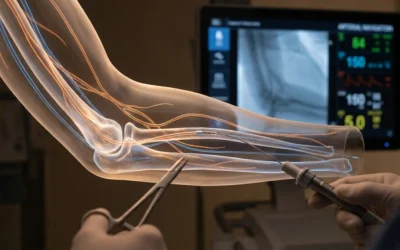
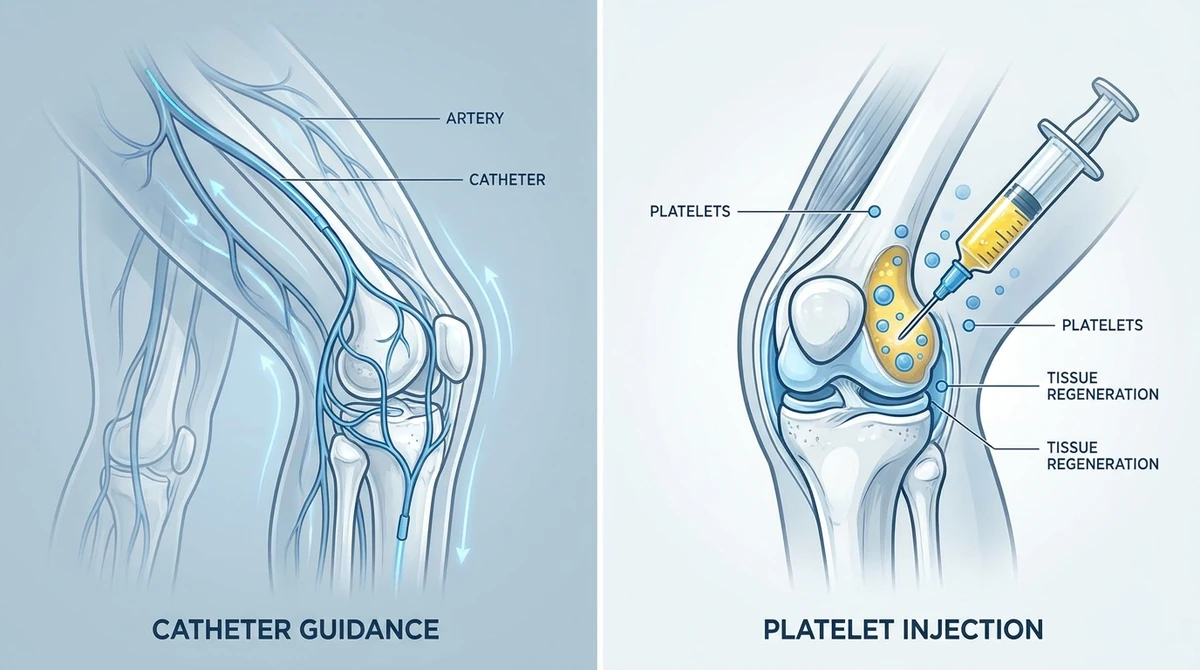
An interventional radiologist uses imaging technology to guide a small catheter through an artery and into the genicular arteries supplying the affected area. Once the appropriate vessels have been identified, tiny embolic particles are carefully delivered to reduce abnormal blood flow.
The goal is to decrease inflammatory activity and associated pain while preserving the natural structure of the knee.
GAE does not remove cartilage, replace joint surfaces, or require a large surgical incision. It is generally performed as an outpatient procedure.
What Is PRP Therapy?
Platelet-rich plasma therapy takes a different approach.
PRP uses a concentrated preparation made from the patient’s own blood. A blood sample is drawn and processed to separate and concentrate platelets. The resulting platelet-rich solution is then injected into the affected area.
Platelets contain growth factors and other proteins involved in the body’s healing response. The idea behind PRP is that delivering a concentrated amount of these components to an injured or degenerative area may support healing and influence inflammation.
PRP has been explored for numerous orthopedic conditions, including tendon injuries and knee osteoarthritis. Research into its effectiveness continues, and results can vary based on the condition being treated, the PRP preparation used, and individual patient factors.
GAE vs. PRP: What’s the Main Difference?
The primary difference between GAE and PRP is what each procedure is attempting to accomplish.
PRP introduces concentrated platelets into the knee with the goal of supporting the body’s biological response within the affected area.
GAE does not inject a therapeutic substance into the knee joint. Instead, it uses image-guided catheter technology to selectively target abnormal blood vessels associated with chronic inflammation.
In simple terms, PRP attempts to influence the joint’s healing and inflammatory environment through an injection, while GAE targets the blood supply associated with inflammatory tissue.
Neither procedure is intended to physically replace damaged cartilage or reconstruct the knee. However, PRP is a short-acting solution while GAE offers longer-lasting pain relief.
How Are GAE and PRP Performed?
Another important distinction is the way the procedures are performed.
PRP Therapy
PRP generally involves three basic steps:
- Blood is drawn from the patient.
- The sample is processed to concentrate the platelets.
- The PRP preparation is injected into or around the affected knee.
The procedure is typically completed in an outpatient setting.
Genicular Artery Embolization
GAE is an interventional radiology procedure. A physician makes a tiny access point and introduces a small catheter into an artery. Using real-time imaging, the catheter is carefully navigated toward the genicular arteries surrounding the knee.
The physician identifies abnormal blood vessels associated with the area of inflammation and selectively delivers embolic material. The catheter is then removed, and the access site is covered with a small dressing. GAE is also typically an outpatient procedure, allowing patients to return home following a period of observation.
Which Has the Shorter Recovery?
Both PRP and GAE are considerably less invasive than total knee replacement, and neither requires the extensive rehabilitation associated with replacing the joint. Patients undergoing PRP may experience temporary soreness or swelling around the injection site.
Following GAE, patients may experience temporary discomfort around the catheter access site or treated area. Many people can return to light daily activities relatively quickly, although individual recovery recommendations vary.
Patients should follow their physician’s instructions following either procedure rather than using another person’s recovery timeline as a guide.
What About the Results?
Both GAE and PRP have been studied as treatments for knee osteoarthritis, but neither treatment produces identical results for every patient.
Some patients undergoing PRP report improvements in pain and function. However, PRP preparation methods can differ between providers, and ongoing research continues to clarify which patients are most likely to benefit.
Studies of GAE have also demonstrated improvements in pain and function among appropriately selected patients with symptomatic knee osteoarthritis. Research into long-term outcomes and patient selection continues as the procedure becomes more widely available.
Neither treatment is a cure for osteoarthritis. Both are ways to manage pain, and GAE typically offers longer-lasting relief than PRP. Many patients also report relying less on pain medication, including opioids, in the year after GAE.
The goal is generally to reduce symptoms and improve function, allowing patients to participate more comfortably in everyday activities.
Can GAE Help Patients Avoid Knee Replacement?
One of the reasons patients explore GAE is the possibility of addressing knee pain without immediately undergoing total knee replacement.
Knee replacement can be an effective option for advanced osteoarthritis, particularly when significant structural damage or mechanical problems are present. However, it is also a major surgery involving the removal of damaged joint surfaces, artificial implants, rehabilitation, and a considerably longer recovery.
GAE preserves the natural knee and does not prevent a patient from considering knee replacement later if surgery eventually becomes necessary. For appropriately selected patients, GAE may provide an opportunity to delay or potentially avoid knee replacement, although individual outcomes vary.
Who May Be a Candidate for GAE?
GAE may be considered for patients who have:
- Knee osteoarthritis confirmed through appropriate evaluation
- Persistent knee pain affecting daily activities
- Symptoms that have not responded sufficiently to conservative treatments
- A desire to explore minimally invasive options before knee replacement
- Clinical and imaging findings suggesting GAE may be appropriate
Not everyone with knee pain is a candidate. Pain caused primarily by another condition, such as a significant ligament injury, meniscus problem, or advanced mechanical instability, may require a different approach.
Which Option Is Right for You?
There isn’t a universal answer to the GAE vs. PRP question.
The appropriate treatment depends on why your knee hurts, the severity of your osteoarthritis, previous treatments, imaging findings, overall health, and personal goals.
For some patients, conservative treatment may still be the best approach. Others may choose to discuss PRP with an orthopedic or sports medicine provider. Patients whose pain is associated with knee osteoarthritis and persistent inflammation may benefit from an evaluation for GAE.
The most important step is obtaining an accurate diagnosis rather than selecting a treatment based solely on symptoms or what worked for someone else.
Explore GAE for Knee Osteoarthritis in Orange County
Living with knee osteoarthritis doesn’t necessarily mean moving directly from injections to major surgery. Today’s patients have a growing range of options for managing persistent knee pain.
At California Joint Pain Institute in Irvine, CA, we specialize in Genicular Artery Embolization for appropriately selected patients with knee osteoarthritis. This targeted, minimally invasive procedure addresses abnormal blood flow associated with inflammation while preserving the natural knee joint.
If conservative treatments or injections are no longer providing the relief you need, contact California Joint Pain Institute to schedule a consultation. Our team can evaluate your symptoms, review your imaging and help you understand whether GAE may be an appropriate next step for your knee pain.