Chronic tennis elbow can be frustrating, especially when weeks or months of rest, activity changes, physical therapy, and other conservative approaches have not provided enough relief. For some patients, the advice eventually becomes simply to give the elbow more time and hope the symptoms resolve. When pain continues to interfere with work, exercise, or everyday tasks, however, waiting can be difficult.
Elbow Artery Embolization (EAE) is a minimally invasive, image-guided procedure designed to address abnormal blood vessels associated with chronic inflammation around the painful area of the elbow. Rather than surgically repairing or altering the elbow, EAE uses a tiny catheter to precisely reach and treat these vessels.
If you are considering EAE for chronic tennis elbow, understanding what happens before, during, and after the procedure can make the experience feel much more approachable.
What Is Elbow Artery Embolization?
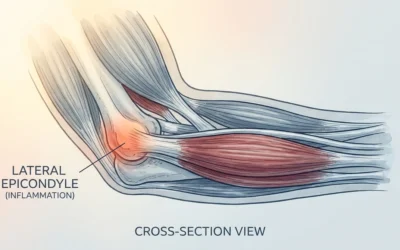
Elbow Artery Embolization is a minimally invasive procedure used for certain patients with persistent tennis elbow, or lateral epicondylitis.
Tennis elbow affects the tendons that attach the forearm muscles to the outside of the elbow. It frequently develops after repetitive gripping, lifting, twisting, or wrist movements place ongoing stress on these tissues.
Despite the name, you do not need to play tennis to develop the condition. Tennis elbow can affect athletes, tradespeople, office workers, and others whose activities repeatedly strain the forearm.
In chronic cases, abnormally small blood vessels can develop around the painful tissue. These vessels are associated with the ongoing inflammatory environment and may contribute to persistent pain.
EAE is designed to selectively reduce abnormal blood flow in this area while preserving normal circulation and surrounding healthy tissues.
What Happens Before EAE?
The process begins well before the actual embolization procedure.
Your physician first needs to determine whether your elbow pain is actually caused by chronic tennis elbow and whether EAE is appropriate for your situation.
During your consultation, your medical team may discuss:
- How long you have experienced elbow pain
- Where your pain is located
- Activities that make your symptoms worse
- Previous injuries
- Treatments you have already tried
- Medications you currently take
- Other medical conditions
Imaging or previous diagnostic studies may also be reviewed.
This evaluation is important because not every type of elbow pain is caused by tennis elbow. Arthritis, nerve compression, ligament injuries, fractures, and other conditions can produce symptoms around the elbow and may require different treatment.
Preparing for Elbow Artery Embolization
If you are a candidate for EAE, your medical team will provide specific instructions for preparing for the procedure.
These instructions may include guidance about eating and drinking beforehand, medications, and transportation home afterward. Certain medications may need to be temporarily adjusted, but patients should only make medication changes under their physician’s direction.
You’ll also have an opportunity to ask questions about the procedure, expected recovery, benefits, and potential risks.
One of the goals at California Joint Pain Institute is to make sure patients understand what is happening at every stage rather than feeling uncertain about the process.
What Happens on the Day of the Procedure?
When you arrive for EAE, the clinical team will prepare you for the procedure and review important medical information.
Unlike traditional elbow surgery, EAE does not require a large incision or surgical exposure of the affected tendon.
Instead, the physician reaches the appropriate arteries through a very small access point.
Medication may be provided to help keep you comfortable. The exact approach can vary based on the individual patient and physician’s procedural plan.
The treatment itself is performed using advanced imaging technology in a specialized procedure suite.
Step 1: Creating a Small Arterial Access Point
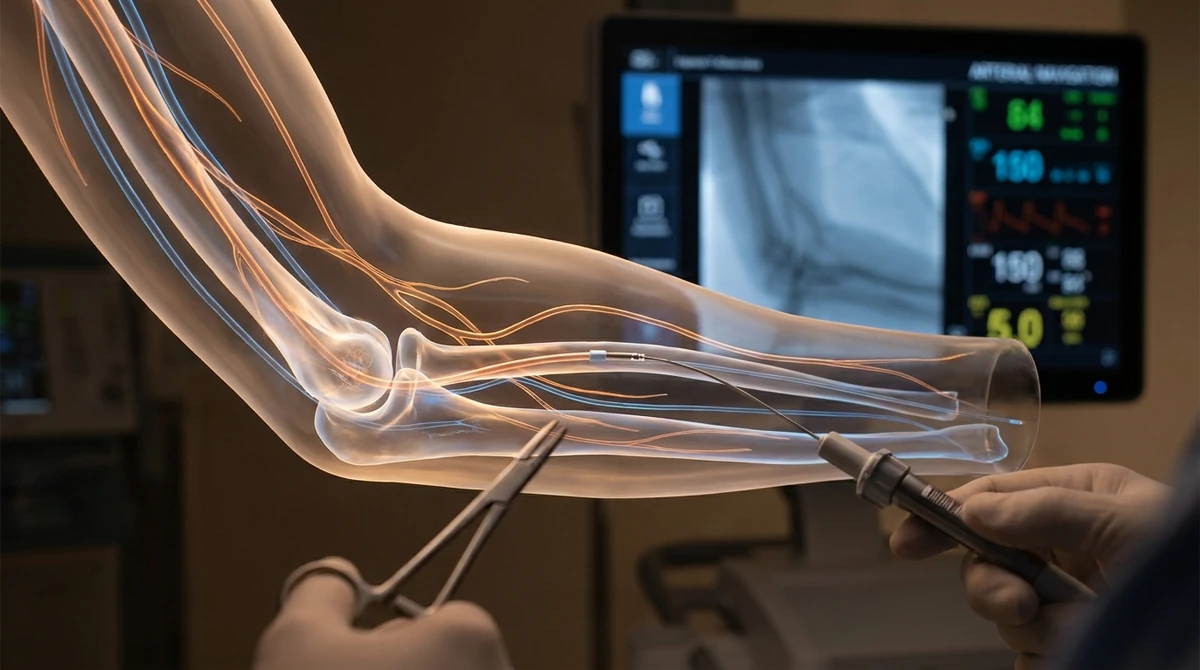
To begin EAE, the physician creates a tiny access point into an artery. Depending on the procedural approach and the patient’s anatomy, access may be obtained from an appropriate artery that allows the physician to safely navigate toward the elbow.
A thin catheter is then introduced into the artery.
This catheter is considerably smaller than a traditional surgical incision and allows the physician to treat the problem from within the blood vessels.
Step 2: Guiding the Catheter Toward the Elbow
This is where image guidance becomes particularly important. Using real-time imaging, the interventional radiologist carefully navigates the catheter through the arterial system toward the small vessels supplying the area around the painful elbow.
Contrast material may be used to help visualize the blood vessels and identify the pattern of abnormal vascularity.
The physician is not simply reducing blood flow throughout the elbow. The objective is much more precise: identify the vessels associated with the chronically painful, inflamed tissue while preserving healthy circulation.
Step 3: Identifying Abnormal Blood Vessels
Chronic musculoskeletal conditions, such as tennis elbow, can be associated with increased vascularity around affected tissue.
During EAE, imaging allows the physician to evaluate this blood flow and identify the vessels that may be contributing to the inflammatory process.
This precision is an important feature of embolization. The treatment can be directed toward specific abnormal vessels rather than altering the elbow joint or tendon itself.
Step 4: Performing the Embolization
Once the appropriate vessels have been identified, embolic material is carefully delivered through the catheter.
This material reduces blood flow through the targeted abnormal vessels. The goal is to interrupt part of the chronic inflammatory process associated with persistent tennis elbow pain.
Healthy circulation to the arm and elbow is preserved through the normal vascular network. The procedure does not remove the tendon, reconstruct the elbow, or require a large surgical incision.
Step 5: Removing the Catheter
After the targeted vessels have been treated, the catheter is carefully removed.
The small access site is then managed with pressure or another appropriate closure method. Because the opening is very small, traditional surgical stitches are generally not part of the procedure.
Patients then move to a recovery area for observation.
What Does EAE Feel Like?
Patient experiences vary, but EAE is designed to be considerably less invasive than traditional surgery. You may notice pressure or other sensations during portions of the procedure, and the medical team can provide medications to help keep you comfortable.
Some soreness around the catheter access site or treated area can occur afterward. Your physician will explain what symptoms are expected and provide instructions for managing temporary discomfort.
Patients should always contact their medical team if they experience symptoms that are unexpected or concerning after the procedure.
Do You Stay in the Hospital After EAE?
EAE is generally performed as an outpatient procedure, meaning an overnight hospital stay is typically unnecessary.
After the procedure, the team monitors the access site and makes sure you are recovering appropriately. Once you are cleared to leave, you can return home with detailed aftercare instructions.
Patients should arrange transportation according to the instructions provided by their care team.
What Is Recovery From EAE Like?
One of the advantages of a catheter-based procedure is that recovery is generally less extensive than recovery from open surgery.
Patients may be able to return to light daily activities relatively quickly, although strenuous exercise, heavy lifting, or activities that place significant stress on the arm may need to be temporarily limited.
Your physician will provide personalized instructions regarding when you can return to work, exercise, and other activities.
Pain improvement may not be immediate. EAE is intended to reduce the inflammatory process, so changes in symptoms may occur gradually as the treated area responds.
Why Consider EAE for Chronic Tennis Elbow?
Most cases of tennis elbow are initially treated conservatively, and many improve over time. The challenge comes when they don’t.
Patients with persistent symptoms may spend months cycling through rest, physical therapy, medications, braces, injections, and activity restrictions. In some cases, they may simply be advised to continue waiting for the tendon to improve.
EAE offers another option for appropriately selected patients.
Potential advantages include:
- Minimally invasive treatment
- Image-guided precision
- No large surgical incision
- Targeted treatment of abnormal vascularity
- Preservation of surrounding healthy tissues
- Outpatient care
- Relatively limited downtime compared with surgery
EAE is not appropriate for every person with elbow pain, and results can vary. A careful evaluation is necessary to determine whether chronic inflammatory vascularity appears to be contributing to a patient’s symptoms.
Learn More About Elbow Artery Embolization in Irvine, CA
Persistent tennis elbow does not always resolve as quickly as patients hope. When months of conservative care have not provided sufficient relief, it may be worthwhile to explore whether another approach is available.
At California Joint Pain Institute in Irvine, CA, we offer Elbow Artery Embolization (EAE) for appropriately selected patients with chronic tennis elbow. Our approach uses advanced image guidance to precisely target abnormal blood vessels associated with inflammation while preserving the natural structures of the elbow.
If tennis elbow continues to make gripping, lifting, working, or exercising uncomfortable, contact California Joint Pain Institute to schedule a consultation. Our team can evaluate your symptoms and help determine whether EAE may be an appropriate option for you.